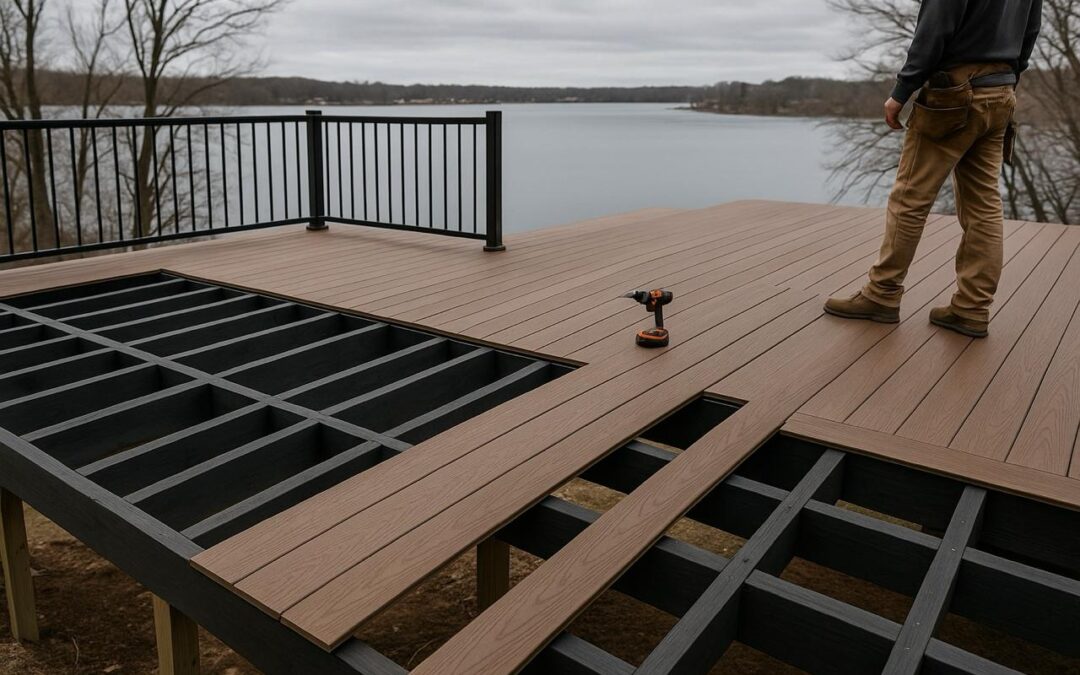
Building the perfect outdoor space starts with choosing the right decking materials — and in Northwestern Illinois, composite decking has become the go-to choice for homeowners seeking durability, low maintenance, and lasting beauty. Whether you’re overlooking the Mississippi River bluffs in Galena or enjoying summer evenings at your Lake Carroll retreat, a well-installed composite deck transforms your property into an entertainment haven that stands up to our region’s demanding climate.
At Oak Leaf Construction, we’ve installed hundreds of composite decks throughout The Galena Territory, Lake Carroll, Apple Canyon Lake and surrounding communities. Our experience spans everything from intimate lakeside platforms to expansive multi-level entertainment spaces, each designed to maximize both functionality and the spectacular views our region offers.
Why Composite Decking Makes Sense in Northwest Illinois
Northwestern Illinois presents unique challenges for outdoor structures. Our weather swings from humid summers to frigid winters — sometimes within a single day — putting tremendous stress on traditional wood decking. Add in the moisture from morning fog rolling off the Mississippi or the constant exposure near Lake Carroll’s shoreline, and you’ll understand why so many homeowners are making the switch to composite materials.
The Climate Factor
Our region experiences temperature variations that can crack and warp traditional lumber. I’ve seen perfectly good cedar decks in Stockton split after just five years due to freeze-thaw cycles. Composite decking, on the other hand, contains stabilizers that handle these temperature swings without the expansion and contraction issues that plague natural wood.
The material’s resistance to moisture is particularly valuable here. Properties near the Galena River or in the heavily wooded areas of The Territory deal with higher humidity levels that accelerate wood decay. Composite boards shed water effectively and won’t rot, split, or develop that gray weathered look that requires constant maintenance.
Long-Term Value for Second-Home Owners
Many properties in our service area — especially in The Galena Territory and Lake Carroll — serve as weekend retreats for families from Chicago, Rockford, and the Quad Cities. These owners need decking that looks great whether they visit weekly or monthly. Composite delivers that peace of mind … no spring staining rituals, no emergency repairs after storms, just consistent good looks year after year.
The investment typically pays for itself within 7-10 years when you factor in the eliminated maintenance costs. No more annual staining at $500-800 per treatment, no board replacements, no splinter removal — just occasional cleaning with soap and water.
Planning Your Composite Deck Project
Successful deck installation begins long before the first board goes down. Proper planning ensures your deck meets community requirements, handles our local conditions, and delivers the outdoor living space you envision.
Understanding Community Requirements
Different communities throughout Northwest Illinois maintain specific architectural standards that impact deck projects:
The Galena Territory requires approval from their Architectural Committee for all exterior modifications. They typically approve earth-tone composite colors that blend with the natural woodland setting. Height restrictions and setback requirements vary by lot location, so we always verify current guidelines before finalizing designs.
Lake Carroll allows more flexibility in color choices but maintains strict requirements for lakefront properties. Decks extending toward the water must comply with both association rules and Illinois DNR regulations regarding shoreline structures.
Apple Canyon Lake focuses primarily on maintaining sight lines to the water and ensuring structures complement neighboring properties. Their review process typically takes 2-3 weeks, so we factor this into project timelines.
For properties outside these communities — whether in downtown Galena, rural Stephenson County, or the farming areas near Pearl City — local building permits still apply. We handle all permitting requirements as part of our comprehensive service.
Design Considerations for Northwest Illinois
Creating the ideal deck layout requires balancing several factors unique to our region:
Sun Exposure: Our summer sun can make south and west-facing decks uncomfortably hot by mid-afternoon. We often recommend incorporating pergolas or planning for future shade structures. Lighter composite colors also help reduce heat absorption — though some homeowners prefer the richer look of darker tones despite the temperature difference.
Snow Load: Decks here must handle significant snow accumulation. While composite decking itself handles snow well, the substructure needs proper engineering. We typically use closer joist spacing (12-16 inches versus the 24 inches sometimes used in warmer climates) to prevent sagging under snow weight.
View Optimization: Whether it’s Eagle Ridge Golf Resort’s manicured fairways, Lake Carroll’s shimmering waters, or the rolling hills visible from properties near Mount Carroll, maximizing views drives many design decisions. We position deck boards to lead the eye toward these vistas and carefully plan railing heights to frame rather than obstruct scenic views.
Wildlife Considerations: Properties in wooded areas — particularly common in The Galena Territory — need to account for local wildlife. Proper disposal of construction materials and strategic placement away from deer paths helps avoid conflicts. We’ve even designed special gate systems for clients who enjoy wildlife watching but want to keep deer off their outdoor furniture.
Essential Materials and Components
Selecting the right composite decking products involves more than picking a color you like. The choices you make impact everything from installation methods to long-term performance.
Composite Board Options
Today’s market offers two main categories of composite decking:
Capped Composite features a protective polymer shell around a composite core. Brands like Trex Transcend, TimberTech AZEK, and Fiberon Horizon offer superior stain and fade resistance. These perform exceptionally well in our climate, handling everything from spilled brats at summer cookouts to wet leaves sitting through fall. The investment runs $12-18 per square foot installed, but the performance justifies the cost for most homeowners.
Uncapped Composite costs less ($8-12 per square foot installed) but requires more careful maintenance. While still outperforming wood, these boards can show some fading and are more susceptible to staining. They work well for covered areas or properties where budget constraints exist.
Hidden Fastener Systems
Modern composite decking installation relies heavily on hidden fastener systems that create smooth, screw-free surfaces. These systems offer several advantages:
- No visible screw heads to collect dirt or create tripping hazards
- Consistent spacing between boards for proper drainage
- Reduced risk of water infiltration at screw holes
- Easier snow removal without catching shovel edges
Popular systems include Trex Hideaway, TimberTech CONCEALoc, and the Fiberon Phantom system. Each works slightly differently, but all achieve that clean, professional appearance our clients expect.
Critical Accessories
Beyond the decking boards themselves, several components ensure long-term success:
Flashing Tape: We apply butyl tape to all joist tops before installing decking. This critical step — often skipped by less experienced installers — prevents moisture from rotting the substructure. Given our wet springs and snowy winters, this $200 investment can add decades to your deck’s lifespan.
Proper Ventilation Components: Composite decking needs airflow beneath to prevent moisture buildup. We incorporate ventilation strips and ensure adequate ground clearance, particularly important for lakefront properties where morning fog is common.
Color-Matched Fascia: Finishing the deck perimeter with matching fascia boards creates a polished look while protecting the substructure. We’ve found this especially important for elevated decks where the underside is visible from yard level.
Professional Installation Process
Installing composite decking requires precision and attention to detail at every step. Here’s how we approach each project to ensure lasting results.
Site Preparation and Foundation
Proper preparation of the base prevents future problems and ensures a level, stable deck. For new construction, we begin by:
Establishing Drainage: Northwestern Illinois’s clay-heavy soils require careful water management. We grade sites to direct water away from the house and install French drains when necessary. Properties in areas like Pleasant Valley or the lowlands near Shannon often need extra attention to drainage details.
Setting Footings: Our frost line reaches 42 inches, so footings must extend at least this deep. We use 12-inch diameter concrete piers for most applications, increasing to 16 inches for elevated decks or those supporting hot tubs. The limestone bedrock common around Galena sometimes requires special drilling equipment, which we factor into project timelines.
Creating Proper Ground Cover: We install landscape fabric and gravel beneath deck areas to suppress weeds and improve drainage. This step proves especially valuable for second-home owners who aren’t present for regular maintenance.
Framing for Longevity
The substructure determines a deck’s durability more than any other factor. We follow these principles:
Material Selection: While some contractors use standard lumber, we specify ground-contact rated pressure-treated wood for all structural members. The minimal extra cost provides significant protection against our humid conditions.
Joist Spacing: Composite decking manufacturers specify maximum joist spacing, typically 16 inches on center for perpendicular installation. We often reduce this to 12 inches for diagonal patterns or high-traffic areas. This prevents the subtle flexing that can occur with wider spacing.
Slope for Drainage: A 1/8-inch per foot slope away from the house ensures water runs off rather than pooling. This proves critical during spring thaws when snow melts rapidly but refreezes at night.
Blocking and Support: We install blocking between joists at 8-foot intervals to prevent twisting and provide solid attachment points for railing posts. This extra framing work eliminates the squeaks and movement that develop in less thoroughly built decks.
Board Installation Techniques
The actual installation of composite boards requires different techniques than traditional wood:
Temperature Considerations: Composite decking expands and contracts with temperature changes. We adjust spacing based on installation temperature — tighter gaps on hot days, wider on cold ones. Our experience with Northwestern Illinois’s temperature swings helps us predict the right spacing for year-round performance.
Board Layout: We typically start installation at the house and work outward, checking for straightness every few boards. Picture framing (installing border boards) creates an elegant finished look but requires precise measuring and cutting.
Fastening Methods: Hidden fasteners go in at specific angles to ensure proper holding power. We’ve found that rushing this step leads to loose boards and squeaking within a few seasons. Each fastener must seat completely before moving to the next position.
End Gaps and Seams: Boards need room to expand lengthwise as well. We maintain manufacturer-specified gaps at butt joints and where boards meet the house. These gaps get covered with color-matched seam strips that allow movement while maintaining appearance.
Cost Considerations for Northwestern Illinois Projects
Understanding the investment required for a quality composite deck helps with budget planning and decision-making. Here’s what homeowners throughout our service area can expect:
Pricing Breakdown
For a typical 16×20-foot deck (320 square feet) in Northwestern Illinois:
|
Component |
Cost Range |
|
Capped Composite Decking |
$3,200 – $5,100 |
|
Substructure Materials |
$1,600 – $2,400 |
|
Hidden Fasteners & Hardware |
$320 – $480 |
|
Fascia & Trim |
$400 – $640 |
|
Professional Installation |
$3,200 – $4,800 |
|
Total Investment |
$8,720 – $13,420 |
These ranges reflect the varying complexity of projects throughout our service area. A straightforward ground-level deck in Lena costs less than an elevated structure in The Galena Territory requiring special engineering for hillside lots.
Factors Affecting Cost
Several elements influence final project pricing:
Site Accessibility: Properties in established neighborhoods like those around downtown Mount Carroll offer easy access for materials and equipment. Conversely, some Galena Territory lots require hand-carrying materials down steep slopes, increasing labor costs.
Existing Structure Removal: Many projects involve demolishing old wood decks first. Disposal costs vary by location — Carroll County’s landfill fees differ from Jo Daviess County’s, for instance.
Special Features: Built-in seating, lighting, or multi-level designs add value but increase costs. We often incorporate these elements for lakefront properties where outdoor entertaining is paramount.
Seasonal Timing: Late spring through early fall represents peak season, when material availability is best but labor schedules are tightest. Winter planning for spring installation often yields better pricing and scheduling flexibility.
Return on Investment
Composite decking typically returns 60-80% of its cost at resale — higher than many home improvements. For vacation properties, the value extends beyond pure financial return:
- Reduced maintenance creates more leisure time during visits
- Consistent appearance maintains property appeal for rental income
- Durability eliminates emergency repair calls while owners are away
Long-Term Care and Maintenance
While composite decking requires far less maintenance than wood, proper care ensures it maintains its beauty throughout our challenging seasons. Research shows that properly maintained composite decking can maintain its long lifespan with minimal effort.
Seasonal Maintenance Schedule
Spring (April-May): After the last frost, we recommend a thorough cleaning to remove winter debris. A soft-bristle brush and composite deck cleaner removes pollen, dirt, and any mold that developed during wet conditions. Pay special attention to shaded areas where moisture lingers.
Summer (June-August): Regular sweeping prevents dirt buildup that can cause staining. For properties near farm fields — common around Cedarville or Orangeville — more frequent cleaning removes agricultural dust that settles during planting and harvest seasons.
Fall (September-November): Remove leaves promptly, especially from valleys where boards meet. Wet leaves left through winter can cause staining on some composite materials. Consider installing gutter guards if overhanging trees drop significant debris.
Winter (December-March): Use plastic shovels for snow removal to avoid scratching. Many homeowners apply a light coating of car wax before winter — it helps snow slide off more easily and provides extra protection against ice-melt chemicals.
Addressing Common Issues
Even quality composite decking occasionally needs attention. Some composite boards may be prone to problems like delamination over time, though modern manufacturing has largely eliminated these issues:
Staining: Most stains clean up with dedicated composite cleaners. Oil-based stains (from grills or food) respond well to degreasing agents. We keep sample cleaners at our shop and happy to recommend specific products for different stain types.
Scratches: Light scratches often blend in over time. Deeper gouges can be minimized using a heat gun to carefully reform the material — though this requires practice to avoid damage.
Fading: While minimal with quality products, some fading occurs over 10-15 years. Unlike wood, you can’t restain composite, but manufacturers offer restoration products that revive color and protect against further UV damage.
Mold and Mildew: Properties in shaded areas or near water face higher risk. Regular cleaning prevents buildup, but established growth requires specific composite-safe mold removers.
Final Inspection Best Practices
Once we finish the installation, the next step is a full inspection. We check for any uneven boards, loose fasteners, or raised edges. Running our hands along the deck can help us find spots that need attention.
We verify all railing posts are upright and do not move when pushed. Corners and joint areas are checked for gaps or poorly fitted pieces. If any composite boards show damage, we replace them right away.
Using a checklist, we note issues like leftover debris, tool marks, and dirt. All surfaces must be clean and clear of sharp edges or splinters. This thorough approach ensures your deck meets our high standards for quality and safety.
Making the Investment in Quality Outdoor Living
A professionally installed composite deck transforms how you enjoy your Northwestern Illinois property. Whether hosting summer gatherings overlooking Lake Carroll, enjoying morning coffee amid The Galena Territory’s natural beauty, or creating the perfect entertainment space for your Stockton home, the right deck becomes an integral part of your lifestyle.
The key lies in working with contractors who understand both the material and our unique regional challenges. At Oak Leaf Construction, we combine decades of local experience with certified installation expertise from leading manufacturers. We know that properties in Elizabeth face different conditions than those in Pearl City, and we tailor each installation accordingly.
Our commitment to quality extends beyond installation. We provide comprehensive project documentation, including detailed proposals that outline every aspect of your deck project. This transparency ensures you understand exactly what you’re investing in and what to expect throughout the process.
Resources for Northwestern Illinois Homeowners
For additional information about deck projects in our area:
- The Galena Territory Association: Architectural guidelines and approval forms (815-777-2000)
- Lake Carroll Association: Lakefront construction requirements (815-493-2552)
- Jo Daviess County Building Department: Permit applications and code requirements (815-777-0357)
- Carroll County Building Department: Permit information for Lake Carroll area (815-244-0221)
- Illinois Department of Natural Resources: Shoreline construction regulations for lakefront properties
- Technical Research: Composite decking installation guidelines from transportation research
Frequently Asked Questions
We address the most common questions Northwestern Illinois homeowners ask about composite decking installation:
What is the recommended method for installing composite decking with hidden fasteners?
The most common approach uses grooved decking boards and special clips that fit into the board edges. We first lay the starter board and secure it with starter clips. Then, we use hidden fastener clips between each board and fasten them to the joists.
Hidden fasteners give a smooth, screw-free surface and maintain even spacing between boards — critical for proper drainage in our wet spring seasons.
What is the proper way to install composite decking with screws?
For installing with screws, we use solid (non-grooved) decking boards. It’s important to pre-drill holes to prevent splitting. Screws should be placed at least one inch from the edge and driven straight down into the joists.
We use manufacturer-recommended screws to avoid damaging the decking material. This method works well for budget-conscious projects or when hidden fasteners aren’t compatible with your chosen decking.
What are the steps involved in laying composite decking boards without fastening clips?
We position the boards on top of the joists and make sure they’re spaced correctly for drainage. Then, we use composite deck screws to fasten down the boards, starting at one end and working across.
Each board is checked for straightness before securing. We fasten each board at every joist along its length — typically every 16 inches for standard installations in Northwestern Illinois.
What should be placed beneath the composite decking during installation?
We install composite decking on top of a strong subframe made from pressure-treated wood joists. A weed barrier fabric goes beneath to prevent weed growth — especially important for properties near farm fields in areas like Orangeville or Pearl City.
Proper gravel base and drainage considerations keep the deck stable and help avoid the moisture problems common in our region’s clay soils.
What is the cost range for installing composite decking?
The cost to install composite decking in Northwestern Illinois typically ranges from $25 to $45 per square foot. This includes the price of the boards, fasteners, and professional labor.
Prices vary based on:
- Material selection (capped vs. uncapped composite)
- Site accessibility (especially challenging in hillside Galena Territory lots)
- Project complexity (multi-level designs, built-in features)
- Seasonal demand (peak summer pricing vs. off-season discounts)
Are there any disadvantages associated with composite decking that I should consider before installation?
Composite decking costs more upfront compared to traditional wood — typically 40-60% higher initial investment. Some considerations for our region:
- Composite boards feel warmer underfoot in full sunlight (particularly dark colors)
- Repairs can be more complex than simply replacing a wood board
- Color choices are permanent — you can’t stain composite like wood
- Snow and ice may require gentler removal methods to avoid scratching
However, most homeowners find these trade-offs worthwhile given the dramatic reduction in maintenance and superior longevity. For second-home owners especially, the peace of mind often outweighs any disadvantages.
Ready to Create Your Perfect Outdoor Space?
Whether you’re ready to replace that aging wood deck or planning your first outdoor living area, Oak Leaf Construction brings the expertise needed for lasting results. We serve homeowners throughout Galena, The Galena Territory, Lake Carroll, McConnell, Lanark, Mount Carroll, Pearl City, Lena, Cedarville, Orangeville, Stockton, Elizabeth, Scales Mound, Apple Canyon Lake, Pleasant Valley, El Mobile, Shannon, Freeport, and surrounding areas.
Contact us at (815) 541-6355 or visit our website to schedule a consultation. Let’s discuss how a premium composite deck can enhance your property’s value and your enjoyment of Northwestern Illinois’s natural beauty.
Oak Leaf Construction is a full-service contractor specializing in outdoor living spaces, exterior renovations, and custom construction throughout Northwestern Illinois. As certified installers for leading composite decking manufacturers including Trex Pro, we deliver quality installations backed by comprehensive warranties and our commitment to excellence.